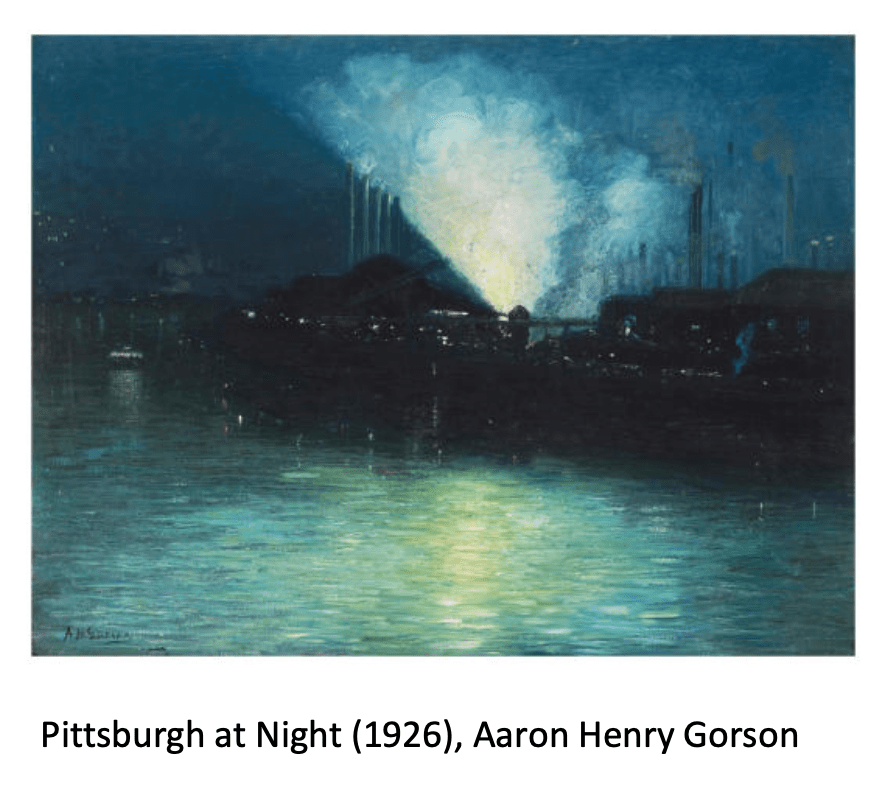
In 1868, James Parton, an Atlantic Monthly writer, visited Pittsburgh and reported: “The town lies low, as at the bottom of an excavation, just visible through the mingled smoke and mist, and every object in it is black. Smoke, smoke, smoke—everywhere smoke.” It was “like looking over into hell with the lid taken off.”
Why was Pittsburgh so smoky and polluted? The steel industry was the culprit. In 1875, Andrew Carnegie began steel production at the Edgar Thomson Steel Works in North Braddock. Carnegie adopted the Bessemer process to increase production—which also increased pollution and demands on workers. Steel mills operated around the clock and living conditions for workers and their families became increasingly difficult.
Skilled workers at the steel mills in Homestead were members of the Amalgamated Association of Iron and Steel Workers which had bargained exceptionally good wages and work rules. Homestead’s management, with millionaire Andrew Carnegie as owner, was determined to lower its costs of production by breaking the union. In 1892, Carnegie and his Chairman, Henry Frick, were determined to break the union, taking the following steps:
- Demanding wage cuts from 325 employees, despite previous pay cuts three years previously
- Advertising for strikebreakers and building a 10-foot fence around the plant topped by barbed wire to provoke a strike
- Sneaking in 300 Pinkerton agents on river barges before dawn on July 6, 1892
These measures led to a battle between the workers and the Pinkertons, leaving 10 dead, three Pinkerton men and seven workers. Frick used this as a pretext to bring in 8,500 National Guard troops to take over the town. After this appalling use of military force, against U.S. citizens, in contravention of the Civil War era Posse Comitatus Act, Frick announced: “Under no circumstances will we have any further dealing with the Amalgamated Association as an organization. This is final.” And in November 1892, the Amalgamated Association collapsed.
The events in Homestead inspired a song well known around the country, “Father Was Killed by the Pinkerton Men.” The lyrics of this deeply angry ballad began: “Twas in Pennsylvania town not very long ago,/Men struck against reduction of their pay./Their millionaire employer with philanthropic show/Had closed the works ’till starved they would obey./They fought for home and right to live where they had toiled so long,/But ere the sun had set, some were laid low.”

 Pittsburgh Hearth